

As I wrapped up my Dwelling playthrough this week, it was like playing and writing through concrete-laden Jello. It was already a struggle when I started after Midnight Owl, because I really didn't like the format once I dug into it, but when I laid grief at the feet of my creative self... it got even worse.
Grief is a strange creature, isn't it?
It's natural and alarmingly... normal. We grieve for ourselves, for others, for the world, for the inequity and injustices that permeate society. We grieve for those that live and those that don't. It creates moats and thorns around our hearts if we let it. Grief has the tendency to swallow us whole, bones and all, the sweet agony of it becoming the entirety of life.
I wouldn't say that grief is a friend, or even a wary ally, but it is a far more constant companion in my life than I'd like.
I lost my grandmother at 7 years old; she was my very best friend in the whole world and when she was gone, it's like a part of me died with her. I didn't get a chance to say goodbye; my poor girl self didn't understand why my last hug was The Last Hug. I carry that grief with me even today, as I round the corner to my 40th birthday.
It was a cascade of death throughout my childhood, creating deeper moats and pricklier thorns that bit at me. I became thorny, despondent, isolated. I hated the world around me and worse than that, I hated myself for not being stronger to withstand the onslaught without losing myself to it.
When the grief finally relented (for a time) and I was able to look at myself again, I was in my twenties, falling in love, getting married, and welcoming my two beautiful youngest children into the world.
The years weren't lost, per se, but they were as diminished as I felt.
The texture of grieving while grown
I'm lucky in that I haven't done much grieving of others since I hit my 30s. I've grieved my chosen departure from my home in British Columbia and the loss of many of those local relationships as a result. (Some have stayed, but many couldn't sustain that long distance or didn't want to continue our friendship, which is okay.)
I lost my uncle during COVID, which definitely still hurts. I took it on as my job to support my family, especially my dad, to make sure that they all felt supported during their grief. I did it happily. It's a comfortable place for me to be and it always has been.
I'm grieving what the shape of my '40s will have to look like with a severe osteoarthritis diagnosis in both of my hips. I thought I'd be able to travel a lot more, especially with my children graduating high school within the next five years, but with the degenerative osteoarthritis... who knows?
Grieving while grown takes on a different tone in that my support network isn't limited to my parents and my brother. I didn't have many friends when I was very little because I was so... odd. By my teen years, I had my best friend of over 25 years; he’s been instrumental in sorting out the woman I grew into.
Now that I have partners to hold me steady, I don't wander off the path nearly as much as I used to. I'm able to hold on for my own grief while holding onto everyone else's.
But then she died
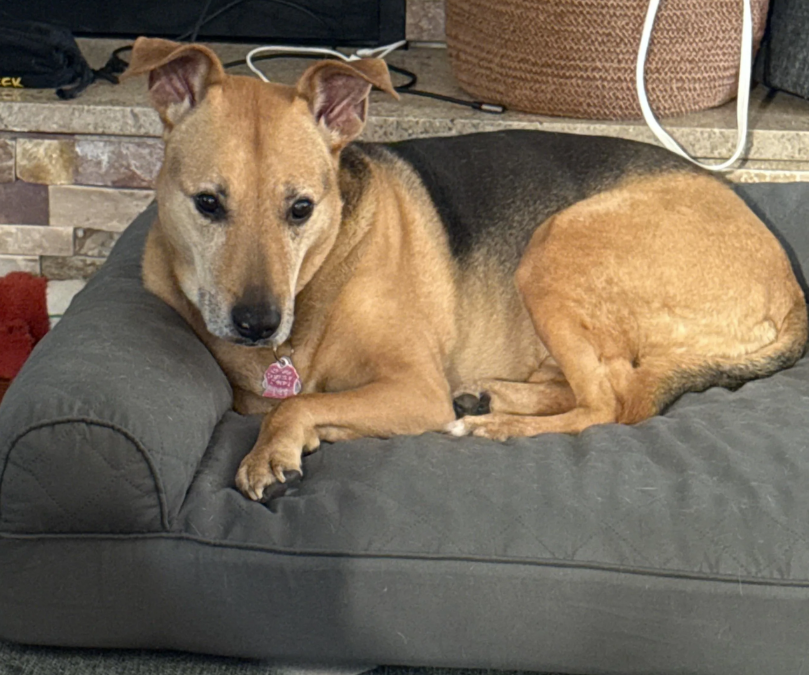
Grieving for an animal isn't new to me, per se, but I've never lost an animal companion while I lived with them.
My grandfather had dogs who passed away, but they weren't mine (even though I loved them dearly). My own dog from my teen years, Gizmo, passed away a couple of months after my son was born, so I wasn't living at home at the time. My mom's brother had a dog that I deeply loved, but he wasn't mine, either.
But Ash? Ash was my best friend, and I saw her every single day for nearly a decade of her 13 and a half years. One day, she was bouncing around and being her happy, beautiful self. The next day, she was gone. (Cancerous tumour around her heart that didn't show up until it was too late.)
When I lost Gizmo, I was a new mother, so I had a baby that needed a ton of love. I didn't have the time to process my grief while also nurturing and caring for an infant. My career was different. My life was different.
Losing Ash, I not only have to walk through my own unrelenting grief, but I also need to hold my four children (one grown) steady through theirs. It's one thing to hold myself (or lean into my partners for their support); it's quite another to ensure that the bulk of that emotional work is poured into the four people that needed me most.
Each child needed something different from me in order to help them process their hurt, which I was glad to do. But holding your son while he sobbed about losing his beloved dog and didn't feel like he had enough time with her (because there's never enough time) is very different than changing his diapers while you're navigating your own grief.
When I lost Gizmo, I was a web designer and had been making websites for about a decade at that point. The work was creative, but it was more science than it was art, more instinct than anything else. Flow was easy.
I make video games now, which is far, far more intensively creative than where I was before. I not only produce games, but I also design, write, and program them. Writing for someone else's vision, executing on time and on tone while fighting to maintain composure every time I hear a song that reminds me of her or catch the scent of morning grass on the air... it felt (and still sometimes feels) nearly impossible.
Breaking through to find the soul of it
This part is the hardest part.
It requires discipline in the midst of a very undisciplined, very emotional process. And, to my own horror, it also requires me to be patient with myself, which I'm not particularly good at.
(I am, however, deeply grateful for the teams that I work with because each of them have been incredibly understanding throughout.)
So, that's part of why I started my Indie RPG A Week Project – it gave me a creative outlet that didn't really need to be anything in particular. It allows me to be creative without the critique, finding freedom in the gentleness of play. (Minus my experiences with Dwelling, but that's personal taste rather than an actual problem with the game itself.)
This project has given me a chance to process my grief without requiring of me. I'm able to just... write. Even before this particular project, I was wading into solo RPGs as a means to process my emotions.
Partway through 2025, I decided to dip into The Last Tea Shop, a solo journaling RPG, while I was flying back from Canada. The Last Tea Shop is about embodying a teamaker on a journey to help souls reach The Land of the Dead. Before I knew it, my tea maker was meeting my uncle on the road, listening to his thoughts about who he was and where he came from. It wasn't a sad reflection. This version of him was happy, free of the pain that drove us apart after my son was born. This version told me about all of the things that he loved most about his life, including his niece and nephew (my brother and me). And, when I was ready to move to my next visitor, I ran into my grandmother (his mother).
Before I knew it, I was crying on the plane and my husband was left wondering what in the heck happened to me in the forty-five minutes that I'd been writing.
(Sorry, love.)
But it broke through some of the grief that I'd been holding back since my uncle died in 2020.
And just this week, I was able to use my Koriko playthrough (the game I've chosen for the next installment of my project) to begin to process some of the trauma I still carry from the Mean Girls I grew up with; Clarabell's (the teenage witch in my playthrough) biggest fear when making new friends is that they'll talk about her behind her back.
It's a process, more than anything
Just like any process, it isn't a straight line.
Some days, I'm able to access the professional creativity that I need in order to meet my deadlines and get things done.
Other days, I'm barely able to write a coherent sentence.
So, it's patience. It's time. It's allowing for creativity to spring up elsewhere and snapping that up when I'm able to. It's rest. It's restoration. It's connection with loved ones. It's remembering (and sometimes, it's forgetting).
Even if the only way out is through, going through takes courage and heart, neither of which are easy to access when the world is heavy.
Each day, I begin again.
So can you.